Timeline
The documented history of the Shroud starts in France around 1354. Before that, its history is a hypothesis, built from images and texts that may or may not describe this cloth. The timeline keeps the two apart.
Where the cloth has been
Solid lines are documented. The dashed route is a hypothesis, mostly from the historian Ian Wilson, that identifies the Shroud with the Image of Edessa (the Mandylion). Most historians do not accept that identification. Between 1453 and 1578 the cloth also traveled with the House of Savoy, so the real documented path has more stops than shown.
The face and a 6th-century icon
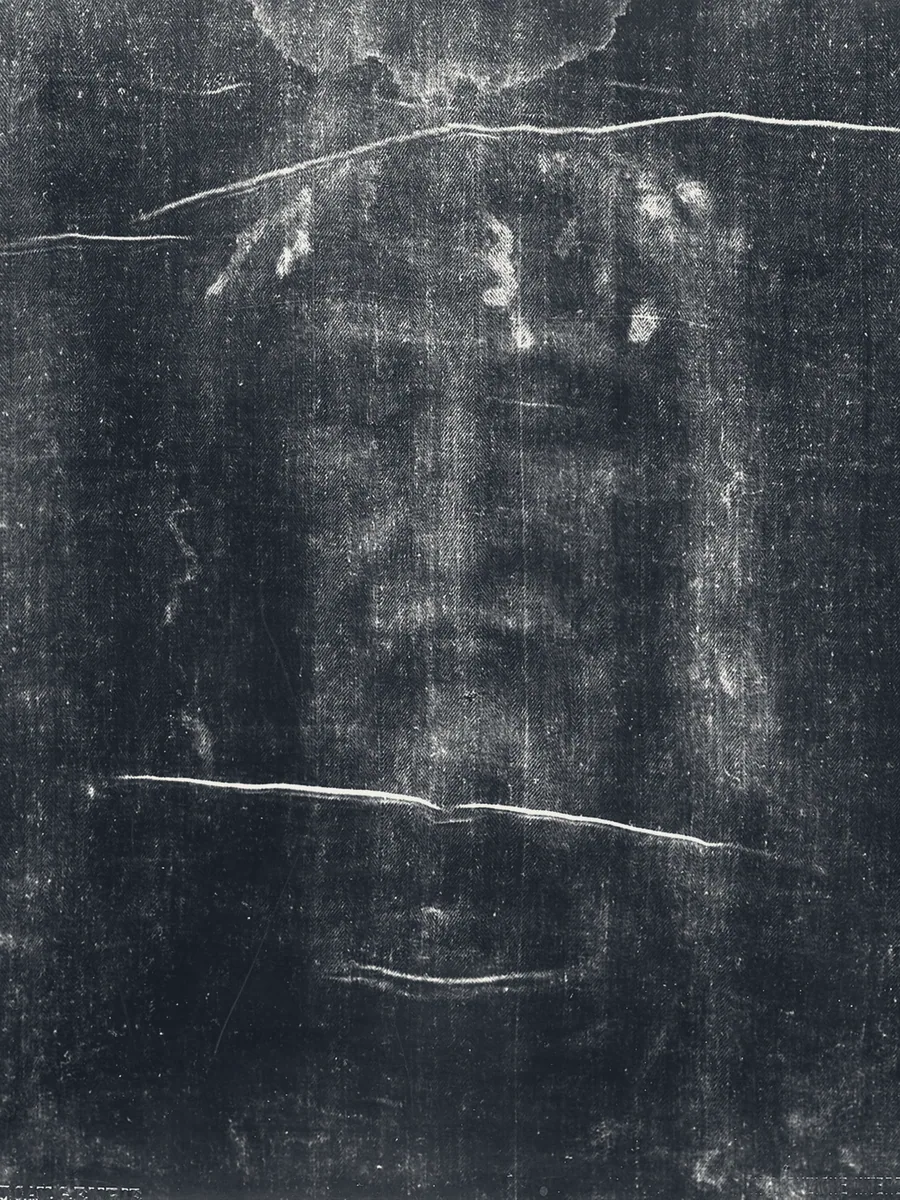
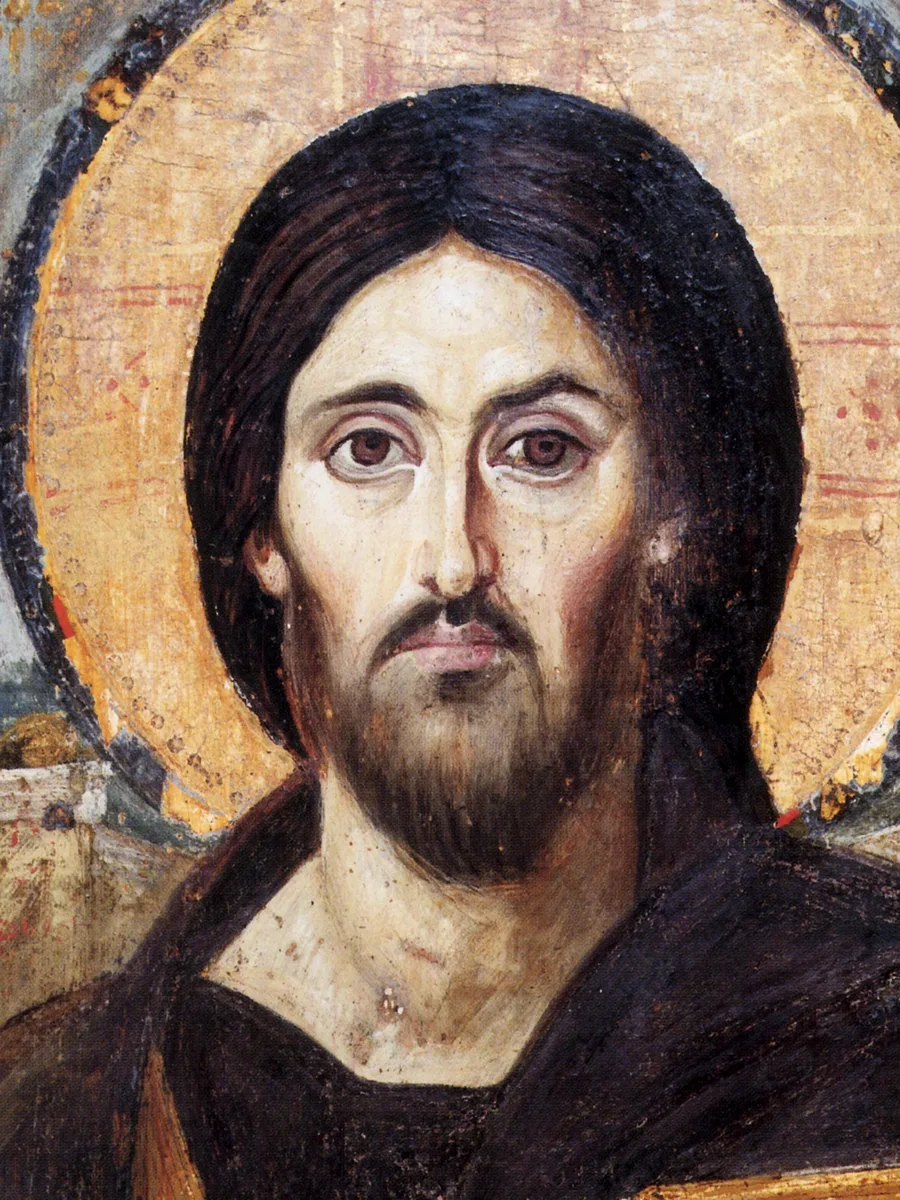
This is the oldest surviving icon of Christ Pantocrator, painted in the 6th century and kept at Saint Catherine's Monastery in Sinai. Slide between it and the face on the Shroud. Both are scaled so the eyes line up.
Supporters of an early history point to shared features: the long nose, the forked beard, the heavy-lidded eyes and the uneven cheeks. In the 1930s Paul Vignon listed small oddities that he believed Byzantine artists copied from the cloth, such as a square shape between the brows.
The skeptic's answer: resemblance cannot tell which came first. A 14th-century artist making a burial cloth of Jesus would have copied the face that icons had made standard. Similarity is consistent with the Shroud being old, and equally with it being made to look like the icons.
Every event
- c. AD 30 or 33
Crucifixion and burial of Jesus
The Gospels say Joseph of Arimathea wrapped the body in a linen cloth (sindon) and laid it in a rock tomb. John mentions linen cloths and a separate face cloth. Any link to this Shroud is a hypothesis.
- early 4th century
Eusebius records the Abgar letters, no image
Eusebius preserves a letter between King Abgar of Edessa and Jesus. No image is mentioned. The image enters the legend later.
- 384
Pilgrim Egeria sees letters, not an image
Egeria visits Edessa and reports the Abgar letters but no image of Christ.
- c. 593
First mention of an Edessa image
Evagrius Scholasticus credits a miraculous image with saving Edessa from the Persian siege of 544. Ian Wilson later proposed this face image was the Shroud folded so only the face showed.
- 614
Sudarium said to leave Jerusalem
Legend says the face cloth now at Oviedo left Jerusalem ahead of the Persian invasion. The story is recorded centuries later by Bishop Pelagius, known as a forger.
- 944
Mandylion moved to Constantinople
The Image of Edessa is taken to Constantinople and placed in the Pharos chapel. The transfer is documented; that it was this Shroud is a hypothesis rejected by most historians.
- 14 March 1075
Sudarium chest opened at Oviedo
Alfonso VI, his sister and El Cid open the chest holding the Sudarium. It is the earliest explicit record of that cloth.
- 1192-1195
Pray Codex drawing
A Hungarian manuscript shows Christ's burial with crossed hands, no thumbs, and a cloth with L-shaped circles like the Shroud's old burn holes. Critics read the object as a decorated tombstone.
- 1203-1204
Robert de Clari's figured shroud
A French crusader writes that a shroud showing the figure of the Lord was raised every Friday at Blachernae in Constantinople. No other source confirms it.
- 1204
Sack of Constantinople
Crusaders loot the city's relics. Some historians suggest a burial cloth disappeared then and later reached France. This is a hypothesis.
- 1287
Templar initiate kisses a linen image
Arnaut Sabbatier testified he was shown a long linen cloth with a bearded man's image at his Templar initiation. Barbara Frale proposed in 2009 that this was the Shroud.
- 20 June 1353
Lirey church founded
Knight Geoffroi de Charny founds a collegiate church at Lirey in Champagne. The official Turin site calls this the start of the first certain evidence.
Archdiocese of Turin: historical outline · Wikipedia: History of the Shroud of Turin
- c. 1355
First showings at Lirey
Canon Robert de Caillac begins exhibiting the cloth at Lirey. Pilgrim badges bearing the Charny and Vergy arms, one now in the Musee de Cluny, show front and back images of a body.
Wikipedia: Shroud of Turin · A Souvenir from Lirey (Cluny badge)
- 1356
Geoffroi de Charny dies at Poitiers
The founder of Lirey is killed at the Battle of Poitiers. He never left a written account of how he got the cloth.
- 1355-1382 (likely after 1370)
Oresme calls a Champagne shroud a fake
Theologian Nicole Oresme cites a church in Champagne claiming the Lord's shroud as a clear case of clerical fraud. The passage was identified by Nicolas Sarzeaud in 2025.
- 1389
Bishop d'Arcis memorandum
The Bishop of Troyes writes to Antipope Clement VII that the cloth is cunningly painted and that an artist confessed to an earlier bishop. The surviving texts are unsigned drafts.
Wikipedia: History of the Shroud of Turin · Markwardt, BSTS Newsletter 99
- 6 January 1390
Clement VII allows display as a 'representation'
The antipope permits showings only if it is announced as a figure or representation, with no candles, incense or guard of honour.
- 1418
Removed from Lirey
During the Hundred Years War, Marguerite de Charny takes the cloth from Lirey for safekeeping. The canons later sue for its return.
- 1453
Passes to the House of Savoy
Marguerite de Charny transfers the cloth to Duke Louis of Savoy. It stays Savoy property until 1983.
- 1506
Julius II approves a feast
Pope Julius II approves a liturgical feast of the Holy Shroud for Savoy on 4 May, treating it as a relic.
- 4 December 1532
Fire at Chambery
Fire in the Sainte-Chapelle of Chambery melts part of the silver reliquary. Molten metal burns through the folded cloth, leaving a symmetrical pattern of holes and scorches.
Archdiocese of Turin: historical outline · Wikipedia: Conservation-restoration of the Shroud of Turin
- 1534
Poor Clare nuns patch the holes
The nuns sew patches over the burn holes and add a Holland cloth backing.
- 1543
Calvin attacks it
John Calvin's Treatise on Relics mocks the shroud shown at Nice as a fake.
- 14 September 1578
Moved to Turin
Duke Emmanuel Philibert brings the cloth to Turin, the occasion being a pilgrimage by Carlo Borromeo. It has stayed in Turin since, apart from wartime removals.
- 1694
Guarini chapel and Valfre repairs
The cloth is placed in Guarino Guarini's chapel, where it rests until 1993. Sebastian Valfre reinforces it.
- 1868
Princess Clotilde repairs it
Clotilde of Savoy repairs the cloth. It is displayed from 24 to 27 April 1868 for the wedding of the future Umberto I.
- 28 May 1898
Secondo Pia's negative
Amateur photographer Secondo Pia finds that his negative plate shows a clear, positive-looking human figure. Modern scientific interest begins here.
- 1902
Vignon studies the image geometry
Paul Vignon studies how a cloth over a body would distort an image and notes the image looks like an orthogonal projection, a point raised again by Moraes in 2025.
Vatican News 2026 · Catholic World Report 2025 (CISS statement)
- 1931
Enrie's photographs
Professional photographer Giuseppe Enrie confirms Pia's result with sharper plates. Enrie's images were used in later 3D and 2025 modelling work.
- 1969
First scientific commission
The Archbishop of Turin appoints a commission, kept confidential at first, to examine the cloth's condition.
- 23 November 1973
First TV exposition and first samples
The cloth is shown live on television. Threads are cut for study, including those Gilbert Raes examined, and Max Frei takes tape samples for pollen.
Archdiocese of Turin: 1973 exposition · Smith on Raes, Shroud Spectrum · Farey 2014 on Frei pollen
- 1976
VP-8 analyser shows 3D information
Using a VP-8 Image Analyzer at Sandia, John Jackson and Eric Jumper find an Enrie photo gives a coherent relief. This leads to the formation of STURP.
- 26 August to October 1978
Public exposition and STURP examination
About 3 million people view the cloth. Afterwards the STURP team studies it for five days around the clock, taking photos, spectra, X-ray fluorescence and sticky-tape samples.
- 1979-1990
McCrone says it is paint
Walter McCrone reports red ochre and vermilion in a collagen binder on the 1978 tapes and concludes it is a 14th-century painting. He leaves STURP in 1980 and publishes his case in Accounts of Chemical Research in 1990.
McCrone Research Institute · Wikipedia: Shroud of Turin · McCrone 1990 (archived)
- 1980
STURP papers in Applied Optics
STURP publishes spectral, infrared, UV and blood results, including Heller and Adler's 'Blood on the Shroud of Turin'.
- 1981
STURP final summary
STURP concludes the image is not paint and not the product of an artist, the stains contain hemoglobin, and how the image formed remains a mystery. Heller and Adler publish their chemical study.
- 1983
Given to the Holy See
Ownership passes from the House of Savoy to the Holy See. A papal custodian, the Archbishop of Turin, looks after it.
- 1984
Image intensity versus distance paper
Jackson, Jumper and Ercoline publish in Applied Optics that image shading correlates with cloth-to-body distance (r squared 0.60 from 13 points).
- 21 April 1988
Radiocarbon sample cut
In the cathedral sacristy, Giovanni Riggi cuts a strip from one corner. Pieces go to Arizona, Oxford and Zurich, with three control cloths. Part is kept in reserve.
- February 1989
Nature publishes AD 1260-1390
Damon and colleagues from the three labs report a 95% range of AD 1260-1390 and call it conclusive evidence of a medieval date. Cardinal Ballestrero announced the official range on behalf of the Church.
- 1990, 1992, 2007
Sudarium of Oviedo radiocarbon dated
Arizona, Toronto and Madrid date the Sudarium to between the 6th and 9th centuries, most likely around AD 700.
- 11 April 1997
Cathedral fire
Fire breaks out in the Guarini chapel. Firefighter Mario Trematore smashes the bulletproof case with a sledgehammer and the cloth is carried out unharmed.
- 24 May 1998
John Paul II: not a matter of faith
In Turin, the pope says the Church has no specific competence to rule on authenticity and entrusts the question to scientists, calling the Shroud a mirror of the Gospel.
- 2000
Great Jubilee exposition
The cloth is shown publicly for the Jubilee year.
- 20 June to 22 July 2002
Major restoration
Mechthild Flury-Lemberg's team removes the 30 patches of 1534 and the Holland backing, fits a new backing, and scans both sides. Some scholars criticise the work as damaging evidence.
Archdiocese of Turin: the restoration · Wikipedia: Conservation-restoration
- 2004
Claimed faint image on the back
Fanti and Maggiolo report a faint face image on the reverse from 2002 photographs. Direct observers in 2002 reportedly saw none.
- January 2005
Rogers: the dated sample was different
Raymond Rogers argues in Thermochimica Acta that the radiocarbon area has cotton and a gum-dye coating and estimates the cloth at 1,300 to 3,000 years old from vanillin loss.
- 2008
Oxford tests the carbon monoxide idea
Christopher Ramsey tests whether carbon monoxide could add young carbon to linen and finds no significant effect.
- October 2009
Garlaschelli's full-size replica
Chemist Luigi Garlaschelli shows a life-size cloth made by rubbing an acidic pigment over a volunteer and a bas-relief, then baking and washing. The paper appears in 2010.
- 2010-2011
ENEA ultraviolet laser studies
ENEA physicists colour linen with very short UV laser pulses and get thin, Shroud-like yellowing. They stress this does not show how the image was actually made.
- 2010
Arizona re-examines a dated fragment
Freer-Waters and Jull find no dye or coating and only a few cotton fibres on a leftover Arizona fragment. The cloth is also shown publicly in 2010.
- 2013
Statistics paper and Fanti's dating book
Riani and colleagues publish the spatial-trend analysis in Statistics and Computing. Fanti announces FT-IR, Raman and mechanical dates near the first century; the Archbishop of Turin says the material's origin is not certain.
- 2014
Freeman's Easter-prop theory
Historian Charles Freeman argues in History Today that the cloth was a faded, once-painted prop for medieval Easter dramas.
- 2015
Exposition and first DNA survey
The cloth is shown with Pope Francis's approval. Barcaccia and colleagues report plant and human DNA from many regions, adding that a medieval European origin is not excluded.
- 2017
Raw radiocarbon data released
After a legal request, the British Museum releases the 1988 labs' raw data to researcher Tristan Casabianca.
- 2018
Bloodstain pattern study
Borrini and Garlaschelli report in the Journal of Forensic Sciences that the blood flows imply inconsistent postures. A public exposition is held in August.
- March 2019
Raw data show heterogeneity
Casabianca and colleagues publish in Archaeometry that the raw data lack homogeneity and the 1988 procedure should be reconsidered, while not ruling out a medieval date.
- Holy Saturday, April 2020
Livestreamed exposition in lockdown
During the COVID-19 lockdown, the archdiocese shows the cloth by television and online. Pope Francis calls it an icon of the crucified, dead and risen Lord.
- 2020
Two more statistical reanalyses
Walsh and Schwalbe, and Di Lazzaro and colleagues, publish that the shroud results are heterogeneous with a spatial trend and that the medieval conclusion should be reconsidered.
- April 2022
WAXS dating of one thread
De Caro and colleagues report in Heritage that one thread's cellulose ageing matches a Masada linen of AD 55-74, under assumed storage conditions.
- February 2025
Neutral review: date stands, retest needed
A review in Textiles concludes the evidence against the 1989 date is not enough to overturn it, image formation is still a mystery, and a second radiocarbon test is needed.
- 28 April to 5 May 2025
Digital Shroud for the Jubilee
Instead of a physical exposition, Cardinal Repole presents a life-size digital replica in a tent in Piazza Castello, Turin.
- 28 July 2025
Moraes: a low relief fits better
Cicero Moraes publishes 3D draping simulations in Archaeometry suggesting a low-relief sculpture fits the image better than a body. The Turin centre CISS replies on 4 August that this is not new.
- August 2025
Oresme passage published
Nicolas Sarzeaud publishes the Oresme text in the Journal of Medieval History, the earliest known written rejection of the cloth.
- February 2026
Rebuttal to Moraes in Archaeometry
Casabianca, Marinelli and Piana publish a critique of Moraes's model in the same journal, citing modelling errors and ignored evidence.
- April 2026
Second Arizona fragment examined
Freer-Waters and Jull publish in Heritage Science on a leftover 1988 Arizona fragment. Press reports say they found no sign of a repair or foreign material.
Freer-Waters and Jull 2026, Heritage Science · Farey 2026 blog summary
- 11 June 2026
Regression on the raw data
Riani, Atkinson, Corbellini and Di Lazzaro publish a reanalysis of the raw data in Statistical Methods and Applications, testing all 165,888 possible subsample layouts.
- July 2026
New examination of the Sudarium
EDICES and the University of Oviedo report the first non-invasive technical examination of the Sudarium since 2012.
- July 2026
DNA study of the 1978 samples
Barcaccia and colleagues report in Scientific Reports that the main human DNA matches the scientist who collected the samples, plus many plant, animal and microbial traces. Two reliquary threads date to the 1534 and 1694 repairs.
Barcaccia et al. 2026 · ScienceDaily 2026 · IBT via inkl 2026
- 22 July 2026
Blood and image order tested
Kelly Kearse shows that blood on acid-treated linen blocks later colouring, so 'no image under blood' does not fix the order of events.