Unless I See
EN

How was the image made?

This is the deepest open question about the Shroud. Any explanation, natural or not, has to account for a list of very strange properties. Here they are, followed by every major hypothesis and its problems.

What any explanation must account for

These are the properties reported by the scientific teams that studied the cloth directly. Some are disputed in detail. Together, they are why no one has reproduced the image in every respect.

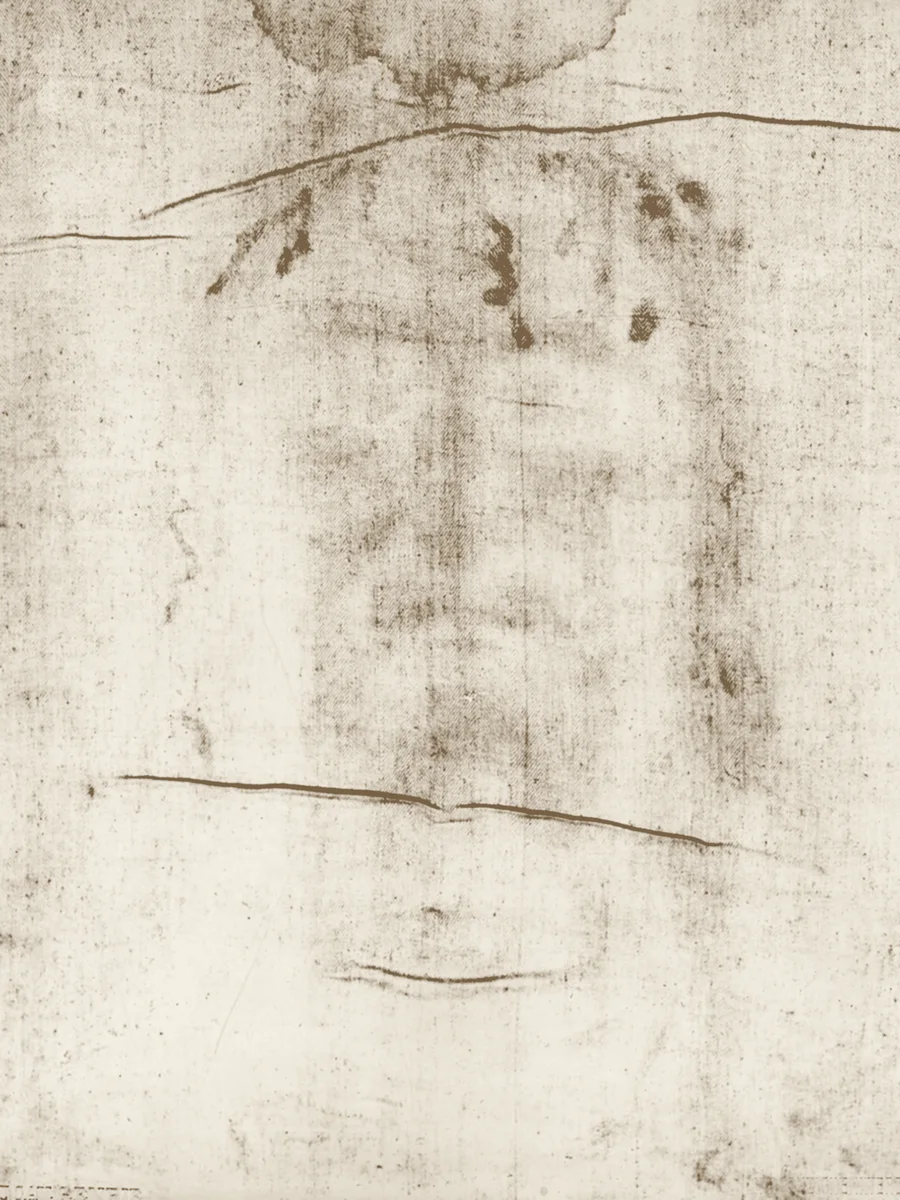
0.2 µmThe color sits only on the outermost layer of the top fibers, according to Rogers and Fanti. A hair is about 70 µm thick.
No paintNo pigment, binder or brush strokes form the image, according to the 1978 team.
NegativeLight and dark are reversed, so the photographic negative looks natural.
3DImage darkness tracks cloth-to-body distance, so it can be turned into a relief.
Blood first?Tests found no body image under the blood stains, which most researchers read as blood first, image second. A 2026 paper argues this does not settle the order.
No glowUnder ultraviolet light the 1532 scorches glow and the body image does not. It is not a simple scorch.
Gaps tooSome image areas were not touching the body, such as between nose and cheek. It is not only a contact print.
Half-toneEach image fiber is either colored or not. Darker areas just have more colored fibers, like a newspaper photo.

How thin is the image?

Use the slider to zoom from the whole cloth down to a single fiber. This is the property that defeats most explanations.

4.4 m

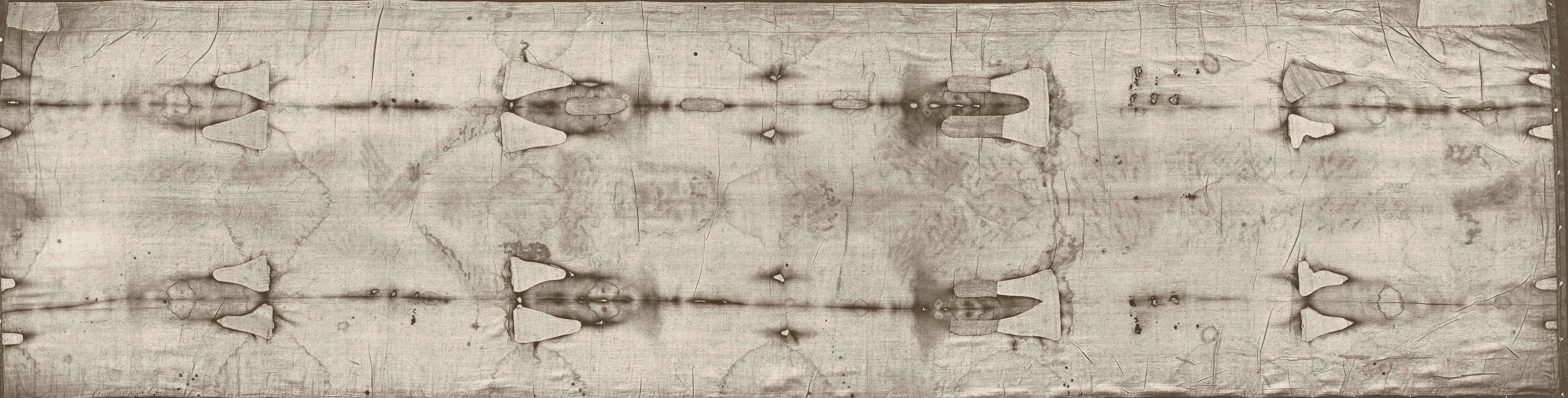
The whole cloth

Front and back images, head to head. From a few steps away, the man is barely visible. The image is that faint.

4.4 m25 cm0.25 mm15 µm0.2 µm

Test each explanation

Here are the six main ideas against the properties above, plus one more question: has anyone made a full image this way?

Which of the image properties each hypothesis can explain
Hypothesis0.2 µm thinNo paintNegative3DBlood firstNo UV glowNot only contactHalf-toneFull image made in a lab
A paintingDoes not explain itDoes not explain itPartly, or disputedDoes not explain itPartly, or disputedExplains itExplains itDoes not explain itExplains it
Scorch from a hot statuePartly, or disputedExplains itExplains itPartly, or disputedDoes not explain itDoes not explain itDoes not explain itPartly, or disputedExplains it
Rubbing over a reliefPartly, or disputedPartly, or disputedExplains itPartly, or disputedPartly, or disputedPartly, or disputedPartly, or disputedPartly, or disputedExplains it
Early photographyPartly, or disputedDoes not explain itExplains itDoes not explain itUntestedExplains itExplains itDoes not explain itPartly, or disputed
Reaction with body gasesExplains itExplains itExplains itPartly, or disputedExplains itExplains itPartly, or disputedPartly, or disputedDoes not explain it
A burst of radiationPartly, or disputedExplains itExplains itUntestedExplains itUntestedExplains itUntestedDoes not explain it
Explains itPartly, or disputedDoes not explain itUntested

This is our summary of what proponents and critics of each idea report. Reasonable people score some cells differently. Note the last column: the hypotheses that explain the most properties are also the ones that have never produced a full image in a lab.

The hypotheses

Ordered roughly from the most natural to the least. Each one is rated by how well it fits the properties above.

Art
Weak

A painting

Microscopist Walter McCrone reported red ochre (iron oxide) on image and blood fibers and vermilion on blood fibers. He concluded in 1980 that a medieval artist painted the image around 1355 with a very dilute paint in a gelatin binder.

Problems with this idea

The STURP team, using X-ray fluorescence, spectroscopy and chemistry on the cloth itself, found no pigment forming the image and no binder, and concluded it is not a painting. Paint would soak between threads; the image does not. Particles of many materials exist on the cloth, plausibly from artists who pressed copies of their paintings against it, as was done for centuries.

Schwalbe and Rogers 1982, Analytica Chimica Acta · STURP final summary, 1981

Heat
Weak

A scorch from a heated statue

A metal statue or relief, heated and covered with the cloth, would leave a brownish, tonally reversed scorch with some depth information.

Problems with this idea

Scorches glow reddish under ultraviolet light. The real scorches from the 1532 fire do, and the body image does not. A hot object would also scorch through the cloth and could not color areas it did not touch.

STURP final summary, 1981

Contact
Disputed

Powder or acid rubbed over a relief

Investigator Joe Nickell, around 1980, made a face image by dabbing powder onto wet linen molded over a bas-relief. In 2009 chemist Luigi Garlaschelli made a life-size image by rubbing an acidic pigment onto linen laid over a volunteer and a bas-relief, then baking and washing the cloth. The results are negative and carry some 3D information. In 2025, Cicero Moraes argued from 3D simulation that the image fits a low relief better than a full body.

Problems with this idea

Defenders answer that these copies are visible to the naked eye in ways the Shroud is not, that their color penetrates the fibers rather than staying on the outer 0.2 µm, that they leave material behind, and that they do not explain why the blood came first. Supporters of the rubbing idea reply that aging and washing over centuries could close part of that gap.

Garlaschelli 2010, Journal of Imaging Science and Technology · Wikipedia: Shroud of Turin, image analysis

Optics
Weak

Medieval proto-photography

Art historian Nicholas Allen proposed in the 1990s that a medieval workshop used a camera obscura with a quartz lens and linen treated with silver salts to "photograph" a corpse or statue.

Problems with this idea

There is no historical record of such a technology for another 450 years, no one has reported silver in the image, and a photograph would not encode cloth-to-body distance the way the Shroud does.

Wikipedia: Shroud of Turin

Chemistry
Disputed

A natural reaction with gases from a body

Chemist Raymond Rogers, a STURP member, proposed a Maillard reaction: gases released by a dead body react with a thin layer of starch and sugar residues left on the linen by ancient weaving methods, producing a faint yellow color only on the surface.

Problems with this idea

This would explain the superficiality and the lack of paint. It struggles to explain the sharpness and the clean distance coding, since gases spread in all directions, and it requires the body to leave the cloth before decay stains formed. No one has produced a full image this way.

Rogers and Arnoldi 2003, Melanoidins

Physics
Disputed

A short burst of radiation

Several physicists suggest the image was caused by a brief, intense burst of energy from the body. ENEA scientists colored linen with ultraviolet laser pulses in a way close to the Shroud. Giulio Fanti proposed a corona discharge. John Jackson proposed that the cloth collapsed through the body as it became mechanically "transparent", recording the image as it fell.

Problems with this idea

There is no known natural source for such radiation from a human body. The energy estimates are enormous. Laser experiments colored only small samples, not an image. Skeptics point out that a hypothesis that requires a miracle cannot be tested like a natural one. Supporters reply that this is exactly why it remains on the table.

Di Lazzaro and others 2012, Applied Optics · Di Lazzaro and others 2010, ENEA workshop · Jackson 1990, Shroud Spectrum International

One hypothesis, visualized. Not evidence.

The light hypothesis, visualized

The animation above shows the hypothesis many people find most compelling: a burst of light from the body, traveling straight up and down, coloring only the surface of the fibers, followed by the cloth falling through. We made it to help you picture the idea. It is a picture of a hypothesis, not a reconstruction of an event and not evidence for it.

A good test of any explanation, natural or supernatural, is whether it accounts for all eight properties at the top of this page at once. So far, none has been demonstrated in the lab to do so.

The ENEA laser experiments

From 2005 to 2010, a team led by Paolo Di Lazzaro at ENEA in Frascati fired ultra-short pulses of ultraviolet light at linen. Within a narrow range of settings, the linen took on a straw-yellow color similar to the Shroud's. Longer or stronger pulses burned the linen, and weaker ones left no visible color until the cloth was aged. The color usually went several micrometers deep. In at least one fiber it stayed in the 0.2 µm outer wall, as on the Shroud.

As a rough sum, they multiplied the laser intensity that worked by the area of a human body. The answer, about 34 trillion watts, is far more than any ultraviolet source built so far. It is a back-of-the-envelope figure for doing it in one pulse, not a measurement of how the image was made. The authors wrote that "nobody can claim" the body image was made by a burst of ultraviolet flashes, and that how it formed is still unknown. What they showed is that this kind of thin coloring is hard to produce at all.