The carbon dating
This is the strongest single argument that the Shroud is medieval, and it deserves a careful look. Here is what was done, what was found, what critics have found since, and what it does and does not prove.
Every date ever proposed, on one line
The twelve measurements behind the date
Each line is one published measurement, with its stated error. The shaded band is the weighted mean, 689 plus or minus 16 radiocarbon years. Because the results scattered too much, the published date used a simple average with a wider error, 691 plus or minus 31. Notice how Oxford sits apart from Arizona. That spread is what later statisticians questioned.
What was done
On 21 April 1988, in the sacristy of Turin Cathedral, Giovanni Riggi cut a single strip from one corner of the cloth, at the edge near the feet of the front image, just above where a sample had been removed in 1973. Textile experts Franco Testore and Gabriel Vial and representatives of the three laboratories watched. Pieces of about 50 milligrams went to three laboratories using accelerator mass spectrometry: the University of Arizona, Oxford University and ETH Zurich. Each lab also received three control samples of known age. The test was not blind: the Shroud's unusual weave made its sample easy to recognize, and the authors said they had given up on blind procedures.
The controls came out right: linen from a Nubian tomb, linen from a second-century mummy, and threads from a 13th-century cope were all dated correctly. The three laboratory averages were then averaged with equal weight: 691 radiocarbon years before 1950, plus or minus 31. The authors used this wider error because the results scattered more than the labs' own error bars allowed. Converted to calendar years, that is AD 1262 to 1312 or AD 1353 to 1384, published rounded as AD 1260 to 1390. The paper in Nature, signed by 21 scientists, called this conclusive evidence that the linen is medieval.
Why it matters so much
Radiocarbon dating is a mature, well-tested method. The controls worked. And the date lands exactly where the documented history begins: the cloth appears in Lirey, France, in the 1350s, and a bishop wrote in 1389 that an artist had confessed to painting it. For many scientists, that coincidence closed the case.
One strip, one corner
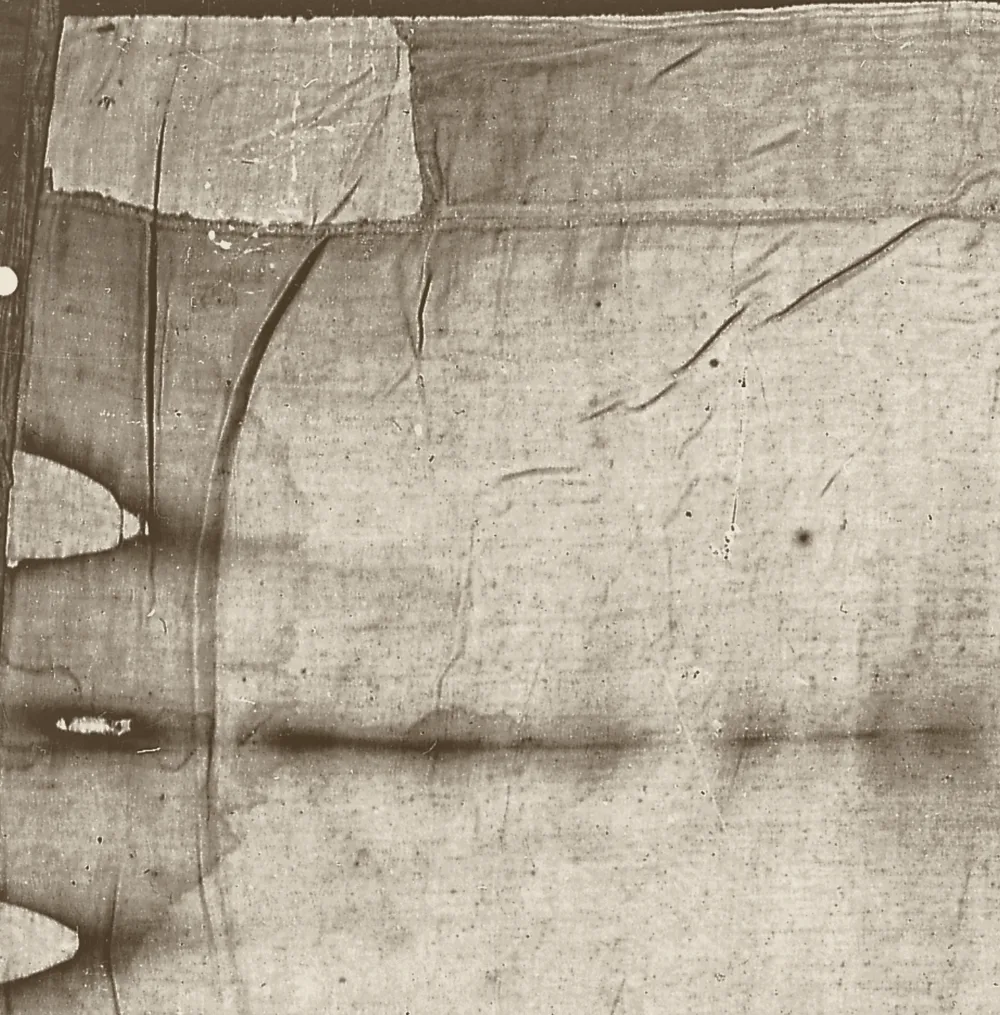
Every result came from a single strip, about 7 to 8 centimeters long, cut from one corner. That corner is thought to have been handled for centuries during public showings, and it lies next to the seam of the side strip. Some researchers have argued it was repaired in the Middle Ages. A 1986 workshop in Turin proposed seven laboratories using two different methods. In 1987 this was cut down to three laboratories, all using the same method, and in 1988 to a single strip from one corner.
Critics say a single corner cannot speak for a 4.4 meter cloth. Defenders of the date reply that the labs examined the sample under the microscope and it looked like the main cloth. In 2010 a leftover Arizona fragment showed no dye or coating and only a few stray cotton fibers. In 2026 the same Arizona researchers reported that two leftover fragments match the main cloth and show no contamination.
Why critics question it
The results do not agree with each other as well as their error bars claimed. The 1989 paper admitted this: the three lab averages fail a standard consistency test, with a chi-squared value of 6.4, just past the 5% threshold. The paper widened its error, but still called the result conclusive. In 2017 the raw data were released after a legal request, and in 2019 a team led by Tristan Casabianca published a reanalysis in Archaeometry. Their consistency test gave 15.99 against a critical value of 5.99, and they concluded the samples were not homogeneous.
Statisticians Marco Riani and colleagues (2013) found that the measured age drifts along the length of the strip, as if something varies across the sample. Other researchers suggested a medieval reweave, contamination, or fire damage from 1532.
Why it is still the strongest argument against
None of these critiques points to the first century. Among the statistical reanalyses of the 1988 data, the largest shift proposed is 88 radiocarbon years (Walsh and Schwalbe, 2020), which still leaves the cloth medieval. Every specific mechanism offered to explain the date away, such as fire, bacteria, carbon monoxide or a burst of neutrons, has either failed a test or cannot be tested.
The repair theory, once popular, is weaker than it was in 2005: the leftover fragments studied in 2010 and 2026 showed no dye or coating and matched the main cloth. In short, the reanalyses show the 1988 test was smaller and less clean than it claimed. They do not show the date is wrong.
Our honest summary
The radiocarbon date says medieval, and it is the best single piece of evidence anyone has. The 1988 test also had real design flaws: one strip, one corner, three labs, and results that do not sit together as neatly as reported. That justifies a new test, with several samples from several places on the cloth, done openly. It does not justify ignoring the result.
If you are a skeptic, this is your strongest card, and you should hold it. If you believe the cloth is authentic, this is the question you have to answer honestly. Either way, the rest of the evidence still has to be explained, starting with how the image was made.